Every IPO season, the same confusion floods investor forums and WhatsApp groups. “GMP is 40%, should I apply?” “What is the Kostak rate?” “Is the grey market the same as buying unlisted shares?” These are not the same question, and the answers lead to very different decisions. This article clears the confusion permanently.
1. What Is the Grey Market for IPO Shares?
The grey market, in the context of Indian IPOs, is an informal, unregulated, over-the-counter market where IPO shares or applications are bought and sold before the official listing on a stock exchange. It operates entirely outside SEBI’s jurisdiction. There are no official exchanges, no legal contracts, and no formal settlement platform. Deals happen through a loose network of specialised dealers, typically reached via calls, messages, and broker networks, and settlement is based entirely on trust and reputation.
The grey market exists because there is a gap between two points in time: the moment an IPO is announced and the moment the shares officially trade on NSE or BSE. In that gap, some investors want to lock in gains early. Others want to buy shares before listing without going through the IPO application process. The grey market fills that gap.
It is important to establish one thing clearly from the outset: the grey market is legal but unregulated in India. SEBI does not govern it. Participants trade based on trust and reputation. No formal settlement platform exists. If a counterparty defaults, there is no legal recourse of any meaningful kind.
Within the grey market, there are three distinct mechanisms that investors encounter. Each works differently and carries different implications.
2. GMP: Grey Market Premium Explained
Grey Market Premium (GMP)
The Per-Share Price Signal Before Listing
GMP is the amount above (or below) the IPO issue price at which shares are trading in the grey market. It is not a transaction in the traditional sense. It is an informal price signal generated by the demand-supply dynamics among grey market participants.
Example: If an IPO has a price band of Rs. 300-321 and the GMP is Rs. 77, it means grey market participants are willing to pay Rs. 398 per share (Rs. 321 + Rs. 77) before the listing. This implies an anticipated listing price around Rs. 398. If the GMP is negative at -Rs. 30, it implies expected listing at Rs. 291, below the issue price.
GMP emerges the moment an IPO is announced and typically moves right up until listing day. The inputs that shape it include the subscription level across retail, NII (Non-Institutional Investor), and QIB (Qualified Institutional Buyer) categories, overall market conditions, sector sentiment, anchor investor quality, and general buzz around the company.
High QIB oversubscription (50x or more) often pushes premiums higher, because it signals that sophisticated institutional money is chasing the IPO. Retail heat amplifies the signal further. But broader market weakness can compress premiums sharply, even for a company with strong fundamentals, simply because grey market participants anticipate a weaker listing environment.
GMP for the Ather Energy IPO in April 2025 reached approximately Rs. 77 per share on the day the IPO opened, implying expected listing gains of roughly 24% over the issue price of Rs. 321. This is consistent with grey market premiums for well-regarded IPOs in positive market conditions.
3. Kostak Rate: The Application Trade
Kostak Rate
The Price Paid for an Entire IPO Application, Regardless of Allotment
The Kostak rate is not a per-share trade. It is the fixed sum that a buyer pays to purchase your entire IPO application, win or lose. If allotment happens, the buyer gets the shares at the issue price. If there is no allotment, the buyer simply pays nothing extra (no shares, no additional cost) and the seller gets the fixed Kostak amount for having applied.
Example: An IPO has a Kostak rate of Rs. 2,000 for one retail lot. You applied for that lot and sold your application in the grey market at the Kostak rate. If you get an allotment, the buyer takes the shares at the issue price. You receive Rs. 2,000 regardless of whether you were allotted or not. The buyer’s risk is the allotment uncertainty.
Kostak trades are typically used when subscription is expected to be very heavy and allotment probability is low. A buyer who wants guaranteed shares pays a Kostak to multiple applicants, betting that at least some of them will be allotted. The seller locks in a fixed gain regardless of outcome, sacrificing any upside from listing gains.
The Kostak market is entirely informal. The moment an IPO closes, the Kostak rate collapses to zero because the allotment outcome is fixed and there is nothing to trade. The window is typically just the 3-5 days that the IPO subscription is open.
4. Subject to Sauda: The Conditional Deal
Subject to Sauda
The Conditional Pre-Allotment Deal
Subject to Sauda (STS) is a conditional grey market deal that is executed only if the applicant receives an IPO allotment. Unlike the Kostak rate (which pays regardless of allotment), STS activates only when allotment is confirmed. The buyer agrees to purchase the allotted shares at a fixed premium above the issue price.
Example: If the STS rate for an IPO is Rs. 400 and the issue price is Rs. 321, the buyer agrees to purchase your allotted shares at Rs. 400 per share, delivering you a Rs. 79 per share profit. If you are not allotted, the deal falls away with no obligation on either side.
STS trades are the dominant form of grey market activity and are what most people mean when they say “I sold in the grey market.” The buyer is essentially pre-purchasing the allotted shares at a premium, betting that the actual listing price will be higher than the STS rate. The seller locks in a certain gain at the cost of missing any additional upside if the listing is spectacular.
The risk for the buyer is that the listing price falls below the STS rate. In that scenario, the buyer has committed to paying Rs. 400 per share for something that lists at Rs. 350. That is a loss of Rs. 50 per share, and there is no contractual recourse.
5. What Are Unlisted Shares and Why They Are Different
Unlisted Shares
Actual Equity Ownership in a Private Company, Legally Held
Unlisted shares are genuine equity shares in a company that has not yet listed on a stock exchange. When you buy unlisted shares, you become a registered shareholder in that company, with your name (or your demat account) on the share register. This is not an informal bet on a listing outcome. It is real equity ownership with all the rights that come with it.
Example: You purchase 100 shares of Reliance Retail (unlisted) through Altius Investech. Those shares are transferred to your demat account. You are now a shareholder of Reliance Retail. You hold those shares for 2-3 years. When Reliance Retail lists on NSE, your shares convert to listed equity and become freely tradable. Your returns are the difference between your entry price and the listing price.
Unlisted shares can come from several sources: existing shareholders (promoters, employees, early investors) who are willing to sell before a listing event; secondary transactions on platforms like Altius Investech that maintain a market in specific unlisted companies; or company-organised transactions such as ESOP buybacks and secondary rounds that allow partial liquidity.
The critical distinction from grey market IPO trading is that buying unlisted shares involves actual share transfer and demat credit. It is legally documented. It involves tax obligations (capital gains on profit, perquisite tax for ESOP exercises). It requires demat accounts on both sides. And it is SEBI-compliant as a transaction category, though the company itself remains unlisted.
6. Grey Market vs Unlisted Shares: The Full Comparison
| Dimension | IPO Grey Market (GMP/STS/Kostak) | Unlisted Shares |
|---|---|---|
| What You Are Buying | A bet on a listing outcome; not actual shares until allotment | Actual equity shares in a real company, transferred to your demat |
| Legal Status | Legal but entirely unregulated. No SEBI oversight | Legal and SEBI-compliant as a transaction type |
| Counterparty Risk | High. Settlement depends entirely on trust. No legal recourse if counterparty defaults | Moderate. Requires a trusted intermediary but involves actual documented transfer |
| Time Horizon | Days (IPO opens to listing, typically 6-10 days) | Months to years (until an IPO or liquidity event) |
| Potential Return | Limited to listing gain (or loss). Typically 10-40% for strong IPOs | Multiples possible if IPO price exceeds unlisted entry price by a wide margin |
| Access Required | Grey market dealers, informal networks | Unlisted share platforms (Altius Investech), intermediary brokers |
| Tax Treatment | Short-term capital gains (STCG) on listing profit, usually at slab rate | LTCG at 12.5% if held 24 months+; STCG at slab rate if held less |
| Demat Involvement | Only post-allotment, and only if you hold (not if you sold in grey market) | Full demat transfer. Shares credited to your account |
| Who It Suits | Short-term traders seeking listing gains from hot IPOs | Long-term investors seeking pre-IPO compounding in quality businesses |
| Manipulation Risk | High, especially in SME IPOs where GMP can be artificially inflated | Lower. Pricing is anchored to last funding round and traded volumes |
7. How Reliable Is GMP as an Indicator?
Investors lean on GMP as a listing predictor constantly, but the reliability varies significantly by context. Studies of Indian IPO data show GMP directional accuracy of roughly 60-70% for large-cap IPOs. That means GMP points in the right direction (gain or loss) roughly two-thirds of the time for major mainboard IPOs. The one-third of the time it is wrong can result in meaningful losses for grey market participants.
For SME IPOs, the reliability is considerably lower. The grey market for SME IPOs is thin and can be easily manipulated. Promoters or operators sometimes inflate GMP artificially to create urgency among retail investors. Many SME IPOs with 50-100% GMPs have listed flat or at a discount. This is a known and documented pattern in India’s IPO market.
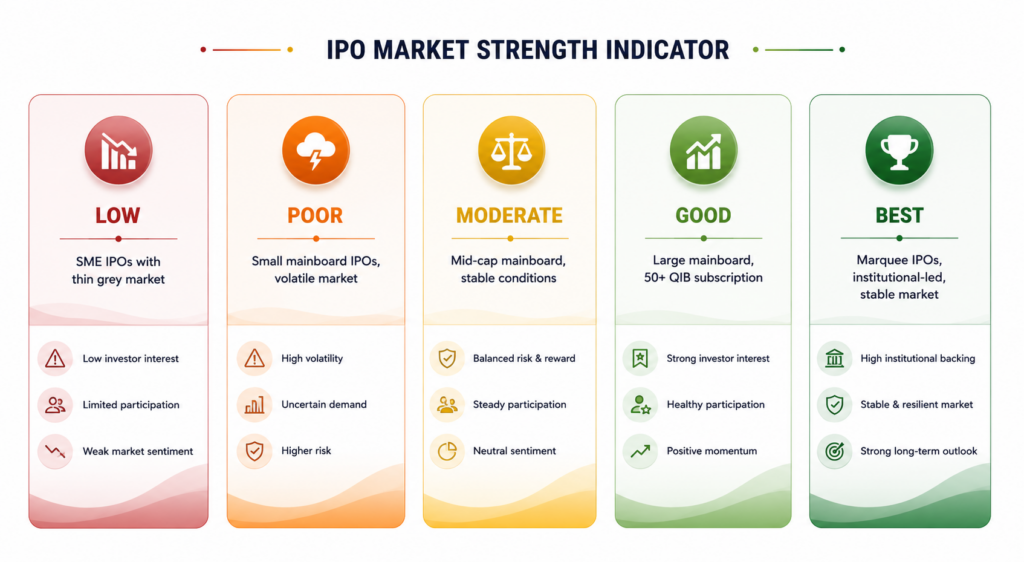
Two additional factors erode GMP reliability. First, GMP is typically set 2-5 days before listing. A sharp fall in the broader market between the GMP setting and listing day can completely invalidate it. Second, GMP reflects the expectations of grey market traders, who are often heavily influenced by recent listing performance, subscription numbers, and general sentiment rather than fundamental business quality. A badly managed company with a hot narrative can have a high GMP. A great business listing in a weak market can have a low or negative GMP.
The GMP trap to avoid: Never apply to an IPO purely because the GMP is high. The grey market premium is a sentiment indicator, not an investment thesis. It tells you what informal traders are willing to pay this week, not what the business is worth over the next three years. Use it as one signal among many, not as a decision driver.
8. Which Should You Be Paying Attention To?
The honest answer depends entirely on your investing style, time horizon, and risk appetite.
Pay attention to GMP if:
- You are a short-term trader who applies to mainboard IPOs for listing gains
- You want a rough directional sense of market enthusiasm for an upcoming large IPO
- You are trying to decide between applying for allotment vs. passing on a particular IPO
- You understand the limitations (unregulated, trust-based, manipulable in SME space) and use it as one signal among many
Pay attention to unlisted shares if:
- You are a patient investor comfortable with a 2-5 year holding period
- You want genuine equity ownership in quality companies before they go public
- You understand the tax treatment of unlisted shares and have incorporated it into your return calculation
- You are working with a trusted, SEBI-compliant intermediary that provides real two-way price quotes and documented transfers
- You want to build a portfolio of pre-IPO positions across sectors, not just trade a single IPO
The key insight: Grey market IPO trading and unlisted share investing are not versions of the same activity. They are fundamentally different in time horizon, risk structure, legal standing, and investment merit. The former is a short-term speculative mechanism with no regulatory protection. The latter is a medium-to-long-term investment strategy with real legal documentation and genuine equity ownership. Calling both “grey market” is one of the most persistent and damaging misconceptions in India’s retail investor community.
How Altius Investech Fits In
Altius Investech operates in the unlisted shares market, not the grey market. Every transaction we facilitate involves actual share transfer, documented counterparties, demat credits, and NEFT/RTGS payment settlement. We provide two-way quotes on over hundreds of unlisted scripts, updated to reflect live market demand. Our 25-year track record in this space means we have seen every market cycle and have the network to source supply and demand on both sides of any transaction.
We do not facilitate Kostak trades, STS deals, or any form of grey market IPO application trading. What we do facilitate is the legal, transparent purchase and sale of genuine unlisted shares in quality Indian companies, from Reliance Retail and PhonePe to mid-size industrials and consumer brands, across every sector of India’s economy.
Those are two completely different markets. Now you know which one is which.
GET IN TOUCH WITH US
For any query or personal assistance, feel free to reach out at support@altiusinvestech.com or call us at +91-6289225026.
Learn more about Unlisted Companies and Pre-IPO opportunities at Altius Investech.
Join our LinkedIn Newsletter: The Market Buzz by Altius