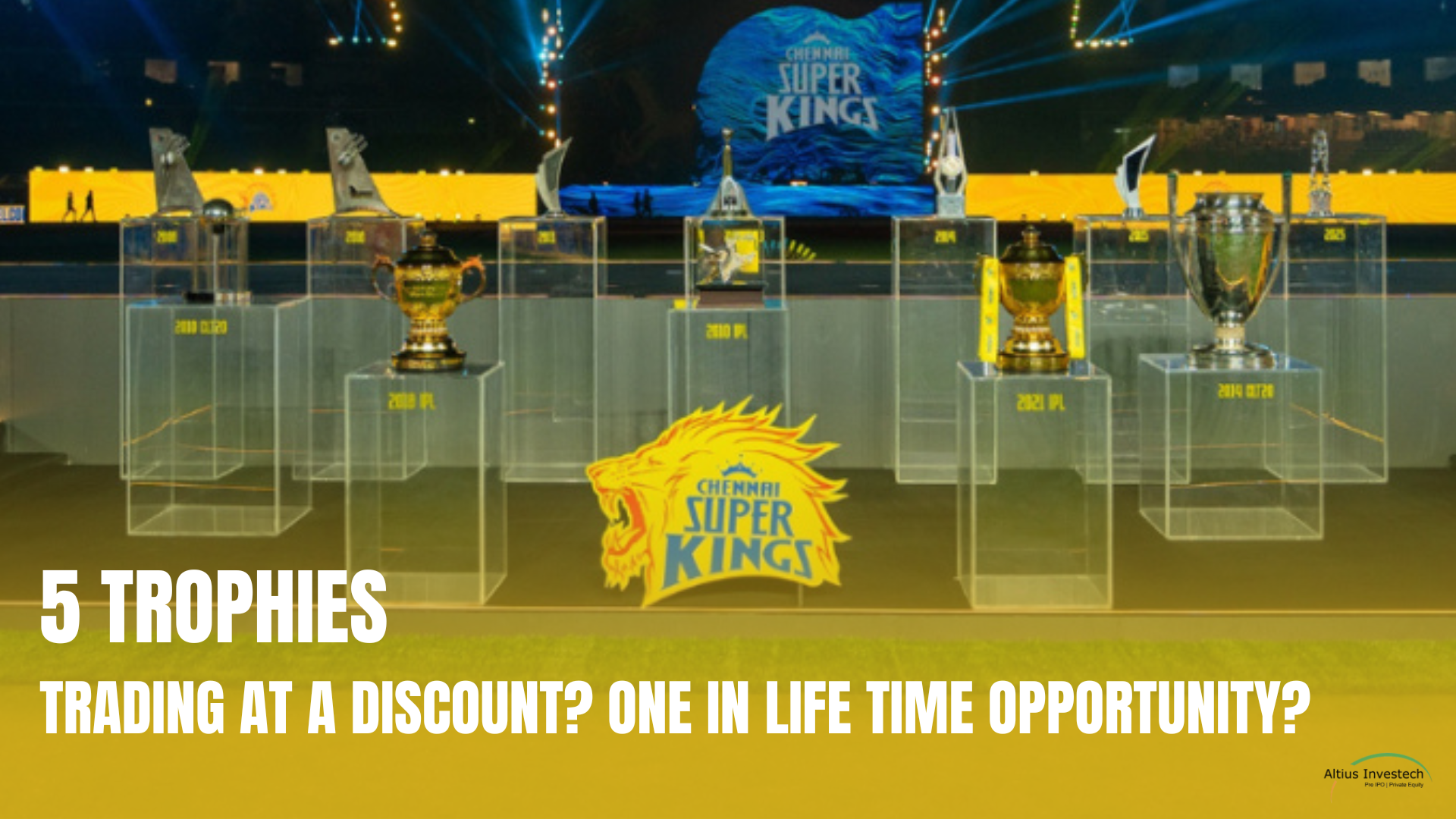
Royal Challengers Bengaluru (RCB)—after there long awaited IPL title got recently acquired for $1.78 billion. Rajasthan Royals, a team with a single legacy title, just sold for $1.63 billion. Meanwhile, Chennai Super Kings, the five-time champion and the most consistently profitable sports media engine in the country, is currently trading in the unlisted market at an implied valuation of $₹10,200 crore. Dalal Street isn’t just buying a cricket team anymore; it is aggressively exploiting a massive, glaring valuation arbitrage.
The Unlisted Sports Play
For a decade, owning a sports franchise in India was the ultimate corporate vanity project. Today, it is a high-margin private equity play. As global consortiums pour billions into the Indian Premier League, the tournament is fundamentally transforming into a standalone asset class. For High Net-worth Individuals (HNIs) and family offices, the unlisted shares of CSK represent the only liquid, accessible gateway to ride this media rights super-cycle before the next major valuation reset.
About the Company: Beyond the Yellow Jersey
Chennai Super Kings Cricket Limited is no longer just a seasonal domestic sports club; it is an asset-light, multinational media conglomerate. Following its demerger from India Cements, the franchise has rapidly expanded its footprint by acquiring the Joburg Super Kings (SA20) and a majority stake in the Texas Super Kings (MLC). Its business model relies heavily on brand monetization, leveraging the immense cultural capital of its leadership to drive predictable cash flows, merchandise licensing, and global academy revenues.
The Financial Engine: Analyzing the FY25 Reality Check
Beneath the fan loyalty lies a brutally efficient financial machine, though FY25 brought a necessary reality check. The franchise reported a Total Income of ₹704.3 crore for FY25. However, Profit After Tax (PAT) dipped to ₹148.3 crore (down from FY24’s peak of ₹201.5 crore), pushing Earnings Per Share (EPS) to ₹3.91.
This contraction wasn’t a structural failure, but a cyclical one: the team finished last in the IPL 2025 season, wiping out tournament prize money, while simultaneously absorbing higher player costs and widening losses from its South African subsidiary. Yet, despite a poor on-field season, CSK still generated ₹221.9 crore in operating profit (a massive ~32% operating margin) and sits on over ₹336 crore in cash with near-zero debt. Most global sports businesses burn cash; CSK prints it, even in a bad year.
The IPL Economics Focus
The true financial moat of CSK isn’t just ticket sales; it is the Board of Control for Cricket in India (BCCI). The IPL operates on a quasi-socialist revenue-sharing model where roughly 73% of a franchise’s top line is guaranteed by the central media rights distribution pool. With the current media rights cycle padding the balance sheets, smart money is already front-running the 2027 renewal. The league is widely expected to aggressively expand its global footprint and match volume, mirroring the English Premier League. This guarantees highly predictable cash flows that heavily insulate the balance sheet from the unpredictability of a single bad season.
The RCB and RR Repricing Angle
The recent 40% rally in CSK’s unlisted equity—pushing the share price from ₹230 past ₹320 in recent weeks—was triggered entirely by its peers. When a Blackstone and Aditya Birla-led consortium acquired RCB for $1.78 billion, the private market violently woke up.
If you map CSK’s unmatched brand equity, consistent profitability, and global expansion against these acquisitions, a clear anomaly emerges. Industry analysts note that CSK is trading at a roughly 30% discount to RCB’s transaction price. The grey market realizes that a five-time champion with a global fanbase should fundamentally command a premium to a zero-title team, despite CSK’s dispersed ownership structure currently capping a strategic buyout premium.
Conclusion: Securing the Arbitrage
The ₹10,200 crore valuation might look steep on a historical P/E chart, but relative to recent private equity buyouts, CSK is undeniably underpriced. However, you cannot buy this asset on standard retail brokerage apps. To secure an allocation of this monopoly before the scarcity premium entirely closes the valuation gap, HNIs must navigate the private markets via specialized platforms like Altius Investech.