
India now has over 300 family offices, up from just 45 in 2018. Their combined AUM runs into hundreds of thousands of crore. For decades, they were principally allocators to public equities, real estate, and fixed income. That is changing. And the shift is happening fastest in one specific area: unlisted shares and pre-IPO equity.
1. The Rise of the Indian Family Office
The family office, as a concept, is not new. The Rockefellers had one in the 19th century. What is new is the speed at which India has produced the kind of liquid, multi-generational wealth that justifies a dedicated investment structure, and the sophistication with which these offices are now deploying it.
India added more than 3,000 new UHNIs (Ultra High Net Worth Individuals, defined as those with net worth above Rs. 50 crore) in a single year according to the Hurun India Wealth Report, creating a deeper pool of sophisticated investors actively seeking alternative avenues. As of early 2026, over 300 family offices now operate in India, a nearly sevenfold increase from 2018.
The shift reflects more than just growing wealth. It reflects a change in how India’s wealthy families think about asset allocation. The first generation of Indian business families largely preserved and grew wealth through the businesses they built. The second and third generations are building professional investment organisations with dedicated teams, structured processes, and return targets that look more like institutional investors than old-money wealth managers.
The AUM for mid to large-sized family offices in India is projected to grow at a CAGR of 14% over the next three years, potentially increasing by 1.5 times, according to a report by Sundaram Alternates. That is not incremental growth. It is structural expansion.
2. Why Unlisted Shares Are Now a Core Allocation
Indian family offices have historically allocated primarily to mutual funds, public equities, and real estate. That pattern is shifting. Alternative investments now account for 40% of Indian family office portfolios, up from just 18% in 2018, one of the highest growth rates in Asia according to the Campden Wealth Asia Pacific Family Office Report.
Within alternatives, unlisted shares and pre-IPO equity have emerged as a particularly attractive sub-category for several reasons.
Access to Growth Before Public Markets Price It In
The single most compelling reason family offices are building unlisted share portfolios is the valuation advantage. By the time a Zepto, a PhonePe, or a Reliance Retail reaches public markets, institutional investors, mutual funds, and retail investors will all compete to own it at whatever price the IPO sets. A family office that accessed the same company at its Series D or through the secondary unlisted market two years earlier participated in value creation that the IPO market never saw.
With an increasing number of startups taking the IPO route, Indian family offices have started to look at them more keenly. The recent surge in Indian IPO volumes, with India leading globally in IPO count in 2024 with 332-337 listings, has demonstrated repeatedly that pre-IPO investors can generate returns that public market entry simply cannot replicate.
Patient Capital Is a Genuine Edge
Unlisted shares are illiquid. You cannot sell them on a Monday morning if the market moves against you. Most institutional investors consider this a bug. Family offices consider it a feature. With no redemption pressure, no quarterly performance reviews, and no mandate to maintain a liquid portfolio, family offices can hold unlisted equity for the 3-7 years it typically takes for value to crystallise through an IPO or strategic acquisition. This “sticky and patient capital” as the market describes it, gives them access to opportunities that funds with mandated liquidity windows cannot participate in.
Diversification Beyond Public Markets
India’s public equity market, while excellent, is correlated. When the Nifty corrects, most public equity portfolios correct with it. Unlisted shares, particularly in early to mid-stage companies, have a return profile that is largely uncorrelated with public market volatility in the short run. For families with substantial public equity exposure, this diversification has genuine portfolio construction value.
The Co-Investment Network Effect
Family offices who have been investing in startups via AIFs for a while have now traded up to become co-investors in funding deals directly. This progression, from passive AIF investor to active co-investor, creates a compounding network effect: deal flow improves, due diligence capabilities sharpen, and access to later-stage rounds becomes possible because of demonstrated track record in earlier ones.
3. Who Is Actually Doing This: Notable Indian Family Offices
The family office universe in India spans from the well-known to the deliberately invisible. Here are some of the more active names building unlisted and pre-IPO portfolios.
Premji Invest
Family office of Azim Premji, founder of Wipro
One of India’s most active and sophisticated family offices. Backed companies including Lenskart, Cult.fit (CureFit), and MobiKwik (which completed its IPO in December 2024). Operates with a sector-agnostic approach with a preference for later-stage ventures. Manages several thousand crore in AUM with a deep team of investment professionals.
Sharrp Ventures
Family office of Harsh Mariwala, founder of Marico
Focuses on equities in India through investments in public market funds, private market funds, and direct investments in unlisted enterprises. Founded in 2014 and based in Mumbai. Has made 51 investments to date with 4 portfolio exits. The firm actively participates in startup rounds across consumer and technology categories.
Catamaran Ventures
Family office of N R Narayana Murthy, co-founder of Infosys
Participated in the Kotak Pre-IPO Opportunities Fund, which invested in PharmEasy, Pine Labs, PB Fintech (Policybazaar), and Nykaa among others. Has investments in Rapido and ShareChat. Often co-invests alongside established VC firms like Lightspeed India Partners.
B2V Ventures, J&A Partners, Kalyan Family Office
Multiple family offices backing Zepto
Participated in Zepto’s 2024 mega fundraise of $350 million. When Zepto raised another $300 million in 2026, multiple single family offices are again reported as participants. This cluster of family office participation in a single growth-stage startup reflects both the increasing sophistication of family office investing and the premium that India’s best growth companies now command from this investor class.
4. How Family Offices Access Unlisted Opportunities
There is no single playbook. Family offices access unlisted shares through several routes, each with different risk profiles, liquidity characteristics, and return expectations.
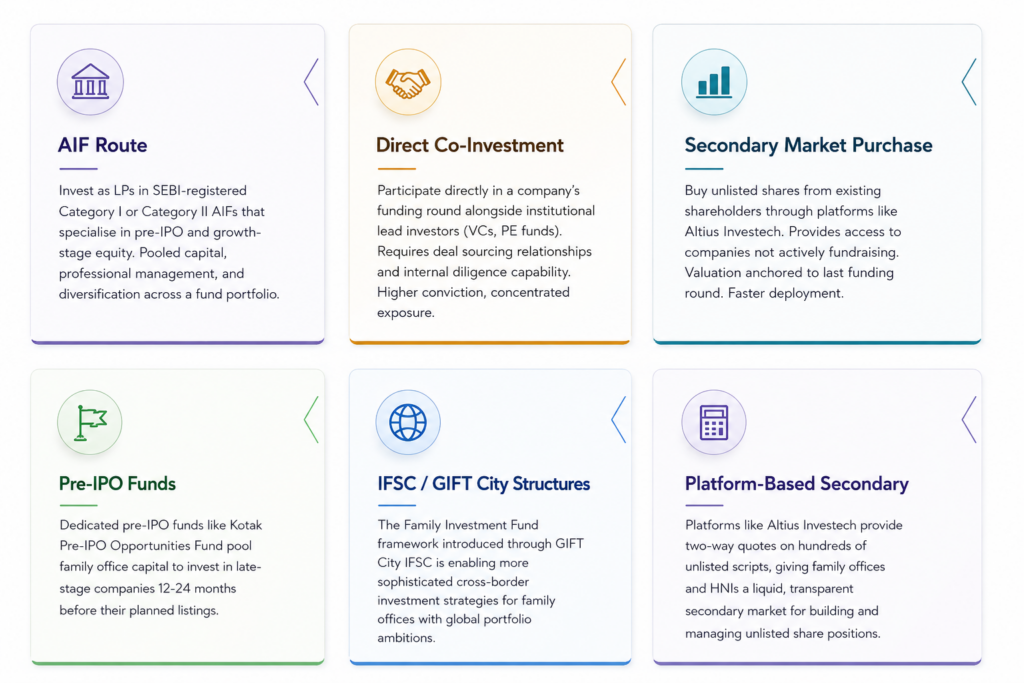
In 2025, 70-75% of the deals executed by family offices were under $10 million, according to the IVCA-Bain report. As family offices gain confidence and build track records, deal sizes are expected to grow. But the current pattern suggests a deliberately diversified approach: multiple small bets rather than concentrated large ones, with the expectation that a handful of them will generate outsized returns through IPO events.
5. What Family Offices Look for in an Unlisted Company
Understanding the selection criteria that sophisticated family offices apply to unlisted investments is valuable for any investor in this space. The filter is different from how a VC thinks about early-stage bets and different again from how a public market investor analyses a listed company.
Institutional Co-Investors Already Present
The presence of established VC or PE funds (Sequoia, Tiger Global, SoftBank, Elevation Capital) as existing investors is one of the primary filters. This is not laziness. It reflects the reality that these funds have access to management, data rooms, and due diligence resources that most family offices do not. Piggybacking on institutional conviction, at a later stage and at a more mature valuation anchor, is a rational approach to filtering the unlisted universe.
Verifiable Revenue at Meaningful Scale
Unlike a VC fund that can write a cheque into a pre-revenue company, family offices almost universally prefer companies with demonstrable, growing revenue. Many family offices allocate across asset classes but invest in the right talent. Revenue is the most accessible proxy for talent. A company growing at 40% annually with Rs. 500 crore in revenue is a credible signal that the team can execute.
A Visible Liquidity Path
Patient capital does not mean indefinite capital. Family offices want to see a credible mechanism for eventual liquidity: a filed DRHP, stated management intent to list, active secondary market demand for the shares, or a sector where strategic acquisition is plausible. The unlisted share itself is not the goal. The liquidity event that realises its value is.
Governance and Promoter Quality
A lot of family offices are operating businesses, many of whom have seen exits via IPOs and offers for sale. They have realised money through the process and understand value creation. This operating experience makes them acute judges of management character. Governance is a non-negotiable filter: ESOP plans, board composition, related party transaction policies, and audit quality are all evaluated seriously.
Valuation Relative to Listed Peers
Family offices do not invest blindly at the last round valuation. They triangulate against listed comparable companies in the same sector. If a listed peer trades at 15x revenue and the unlisted company is being offered at 8x revenue with a faster growth rate, the relative discount makes the unlisted investment compelling. If the unlisted company is priced at a premium to listed peers, the case is much harder to make.
The family office selection framework in brief: Institutional backing present. Revenue growing. Liquidity path visible. Promoter credible. Valuation attractive versus listed peers. This five-point filter eliminates a very large proportion of the unlisted universe and leaves a small set of high-conviction candidates that merit deeper work.
6. What Retail Investors Can Learn from This Playbook
Most of the principles family offices apply to unlisted investing are not exclusive to the ultra-wealthy. They are frameworks that any investor with appropriate risk tolerance and a 3-5 year horizon can apply through the secondary unlisted market.
| Family Office Practice | How Retail Investors Can Apply It |
|---|---|
| Filter by institutional backing | Only consider unlisted companies with at least one recognised institutional investor (Tier-1 VC or PE) already on the cap table |
| Demand revenue visibility | Prefer companies with published revenue data (annual reports filed with MCA, credit ratings, media disclosures) over those with no verifiable financial track record |
| Anchor to a liquidity path | Invest in companies with a stated IPO intent, active DRHP filing work, or strong secondary market demand rather than companies with no visible exit mechanism |
| Triangulate valuation against listed peers | Compare the unlisted ask price to listed comparable companies on revenue multiples before committing capital |
| Size positions conservatively | Unlisted shares should be 5-15% of an overall portfolio for retail investors, not a concentrated bet. Illiquidity demands conservative position sizing |
| Use multiple small positions | Mirror the family office approach of multiple smaller bets rather than one large concentrated position. Diversification within the unlisted bucket matters |
| Work with a trusted intermediary | Family offices co-invest via established VCs. Retail investors should transact unlisted shares through established platforms with track records, compliance infrastructure, and two-way pricing |
The democratisation argument: The unlisted share market is one of the few areas of investing where retail investors and family offices are, at least structurally, accessing the same assets through the same mechanism. A family office buying Rs. 50 lakh of Reliance Retail unlisted shares through a secondary transaction is doing the same thing as a retail investor buying Rs. 1 lakh of the same stock. The due diligence process, the hold period, and the ultimate exit mechanism are identical. The only difference is position size and portfolio sophistication. That convergence is genuinely democratising.
Final Thought
India’s family offices did not arrive at unlisted shares by accident. They arrived there through a logical progression: public equity markets became efficient and expensive. Real estate became operationally complex. Fixed income yields compressed. And India’s startup ecosystem produced a generation of businesses that are genuinely worth owning, at stages where public market access was simply not available.
The family offices that moved earliest into pre-IPO equity, the Premji Invests and Catamaran Ventures of the world, have seen those positions validated through IPO events that generated returns unavailable to public market investors. The money followed. The playbook became clearer. The ecosystem around secondary unlisted trading deepened.
We are now at the point where this is no longer a niche activity for a handful of the largest family offices. It is a mainstream allocation strategy for India’s growing UHNI class. The secondary unlisted market, platforms like Altius Investech, the professional intermediary infrastructure, the two-way quote mechanisms, are what make this possible at scale.
The question for every investor, not just the ultra-wealthy, is whether they understand the opportunity well enough to participate in it wisely. The family offices who do this well are not operating on privileged information. They are operating with better frameworks, longer time horizons, and a willingness to accept illiquidity in exchange for asymmetric return potential.
All three of those things are available to anyone willing to learn how the market works.
GET IN TOUCH WITH US
For any query or personal assistance, feel free to reach out at support@altiusinvestech.com or call us at +91-6289225026.
Learn more about Unlisted Companies and Pre-IPO opportunities at Altius Investech.
Join our LinkedIn Newsletter: The Market Buzz by Altius