
digital lending exploding, the country is rapidly building the financial infrastructure to become a global economic powerhouse. For investors, this credit boom is a direct wealth creation opportunity.
The recent blockbuster public market debuts of industry heavyweights have proven that immense value is locked within India’s shadow banking sector. But while the window for early entry into those giants has closed, the blueprint for success remains.
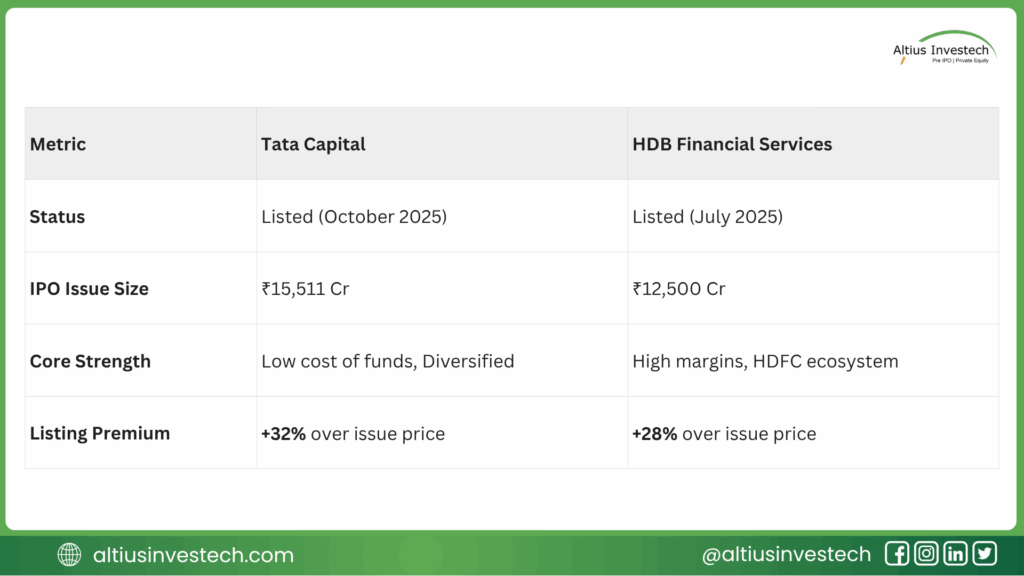
How Tata Capital & HDB Financial Rewarded Early Investors
India’s retail credit market is expanding at a breakneck pace. The regulatory push by the RBI—specifically the upper-layer scale-based regulations—forced massive unlisted players into the public spotlight.
In late 2025, both Tata Capital and HDB Financial Services transitioned from unlisted giants to listed powerhouses. What made them so successful?
- Tata Capital leveraged the pristine trust of the Tata Group, securing an incredibly low cost of funds. By building a highly diversified book across corporate, consumer, and housing finance, they insulated themselves from sector-specific shocks.
- HDB Financial, on the other hand, acted as the high-yield engine for HDFC Bank. By focusing on underbanked MSMEs, commercial vehicles, and consumer finance, they commanded exceptional net interest margins.
Before their respective IPOs, savvy investors heavily researched the parent companies and accumulated pre-IPO stock. Monitoring theTata Capital share price or the HDB share price was a key strategy for institutional buyers looking to enter at a discount to public market valuations. By the time the HDB financial grey market price spiked just before listing, the early movers had already secured their positions. When the companies finally listed, the pent-up demand resulted in massive listing premiums, heavily rewarding those who held Tata Capital or HDB financial Services shares in their private portfolios.
Hero Fincorp — The Auto-Financing Giant Waiting in the Wings
With the massive wealth unlocked by HDB and Tata Capital, the market’s spotlight has firmly shifted to the next major catalyst: Hero Fincorp.
Originally launched as a captive financier for Hero MotoCorp’s two-wheelers, the company has successfully pivoted into a highly diversified retail and MSME lender. This transition is exactly what gives it such high potential. By utilizing the massive, established dealership network of Hero MotoCorp, the company acquires rural and semi-urban customers at a fraction of the cost of traditional banks.
Hero Fincorp’s trajectory shows strong momentum, with its Assets Under Management (AUM) crossing ₹57,000 crore. Crucially, the company received its SEBI IPO approval back in May 2025—nearly a year ago. In the Indian market, regulatory approvals have a finite shelf life, meaning this ₹3,668 crore blockbuster IPO is on a strict ticking clock and could drop at any moment.
As the launch window rapidly narrows, shares in the private market continue to see intense traction. Investors are actively accumulating positions today because Hero Fincorp mirrors the exact pre-IPO setup of its recently listed peers: strong parentage, expanding margins, a massive captive customer base, and a market debut that is now imminent.
Motilal Oswal Home Finance — The Affordable Housing Play
Operating in a highly specialized and rapidly growing segment, Motilal Oswal Home Finance focuses exclusively on the affordable housing space. Unlike unsecured consumer lending, this model is backed by hard collateral. By lending primarily to low and middle-income groups in tier-2 and tier-3 cities, the company captures a high-yield market that larger banks often ignore due to ticket size.
The company continues to post robust loan disbursements, steadily growing its loan book past the ₹4,800 crore mark with excellent capital adequacy. Tracking the motilal oswal home finance share price is essential for those looking for pure-play housing finance exposure. With shares trading at highly accessible entry points in the private market, long-term investors are already modeling the potential upside. The growing anticipation around a future motilal oswal home finance ipo makes adding the motilal oswal unlisted share price to a watchlist a smart move for those seeking the next wave of financial sector wealth creation.
The Macro Tailwind: Why India’s Credit Boom is a Generational Bet
The overarching catalyst behind India’s NBFC and fintech sector is the country’s unprecedented structural credit expansion. For pre-IPO investors, allocating capital here is not just a sector play; it is a leveraged, high-conviction bet on the great Indian financialization story, driven by four key pillars:
- The Massive Penetration Gap: Despite being a top global economy, India’s credit penetration remains surprisingly low. The household credit-to-GDP ratio stands at just 42% — significantly lower than emerging market peers like China (60%) and developed economies like the US (69%) and the UK (76%). Even looking at overall bank credit-to-GDP, India sits at roughly 53%, while advanced economies comfortably exceed 130%. This glaring gap represents a multi-decade runway for credit expansion.
- Explosive Sector Growth (The CAGR Story): This gap is being filled rapidly. The Assets Under Management (AUM) of Indian NBFCs is expanding at a robust Compound Annual Growth Rate (CAGR) of 18% to 22%, vastly outpacing traditional bank credit growth. In high-yield pockets like unsecured personal loans, consumer durables, and micro-lending, growth rates frequently push past the 25% mark. NBFCs are successfully capturing the “missing middle”—tier-2 and tier-3 retail consumers and underbanked MSMEs that traditional banks are too slow to serve.
- The Technology Moat: What makes this cycle completely different from the past is the unit economics. By leveraging India’s world-class Digital Public Infrastructure (DPI)—specifically the Account Aggregator framework, UPI, and AI-driven alternative data—these unlisted giants have drastically lowered their Customer Acquisition Costs (CAC). They are underwriting faster, cheaper, and with far more accuracy than traditional models allowed a decade ago.
- The Regulatory Catalyst: Growth alone doesn’t guarantee a liquidity event for investors, but the regulator does. The RBI’s stringent scale-based regulations now mandate that large, “upper-layer” NBFCs must adhere to strict transparency norms and list on public exchanges within a specific timeframe.
Where to Participate Before the Next IPO
For retail and institutional investors eager to participate in India’s economic boom before companies reach the IPO stage, the unlisted market offers a highly lucrative, albeit illiquid, pathway.
Unlisted shares are traded through specialized platforms that facilitate deals outside of standard stock exchanges. Dedicated platforms like Altius Investech can help you access equity in high-potential companies.
GET IN TOUCH WITH US:
For any query/ personal assistance feel free to reach out at support@Altiusinvestech.com or call us at +91-8240614850.
Learn, more about Unlisted Companies
Join our Whatsapp Channel: The Market Buzz by Altius
📜 Disclaimer
(Data from from public sources & altiusinvestech.com. For educational purposes only; not investment advice. Altius Investech is not SEBI-registered; investors should do their own due diligence.)