
India’s largest stock exchange is standing on the edge of a historic public market debut, armed with a fresh SEBI approval, a sweeping revamp of its share transfer process, and NSE grey market price, pushing its valuation to a staggering ₹5 Lakh Crore.
So, how did the exchange that handles nearly 100% of India’s equity derivatives get here, and what does this mean for the future of the Indian capital markets? Let’s dive into the journey, the roadblocks, the financials, and how you can invest in NSE before it lists.
How NSE Became India’s Biggest Exchange
To truly appreciate the dominance of NSE Ltd today, one must look back at the chaos of the early 1990s. Before its inception, the Indian stock market was plagued by the opacity and delayed settlements of physical open-outcry trading rings. NSE was incorporated in 1992 and launched in 1994, fundamentally revolutionising Indian finance by introducing nationwide, fully automated screen-based trading. Investors in remote towns had the same real-time pricing and market access as seasoned brokers in South Mumbai, laying the groundwork for a transparent financial system.
The exchange’s subsequent growth perfectly mirrored the massive shift in Indian household savings from physical assets to financial ones. Expanding beyond equities, the NSE launched the iconic Nifty 50 index in 1996 and pioneered derivatives trading in 2000. Over the past decade, as demat accounts exploded past the 20-crore milestone, the NSE captured the absolute lion’s share of this retail revolution, now boasting over 12.2 crore unique registered investors.
Business Model: A Powerful, Integrated Ecosystem
The core of the NSE’s success is a highly scalable, tech-driven business model with high profit margins, operating with a near-monopoly structure in key areas. It isn’t just a trading platform; it is a complete, end-to-end financial ecosystem built to be virtually unreplicable.
1. Core Scalable Revenue:
- Transaction Fees: This is the primary and most scalable revenue engine. The exchange charges a fee on every trade—whether a simple cash stock buy or a complex options contract. Crucially, every additional trade contributes directly to the bottom line with virtually zero additional marginal cost to the NSE.
- Derivatives Dominance: The NSE commands a near-total 99% market share in the derivatives segment.
- Cash Segment Leadership: It also holds a commanding 93% market share in the cash equities segment, capturing the vast majority of all stock trading in India.
End-to-End Financial Ecosystem (Subsidiaries): The NSE has built an unbreakable economic moat through its integrated subsidiaries, creating an impenetrable financial ecosystem:
Ancillary Tech Services: Revenue from co-location, platform, network, and terminal charges provides stable, diversified income that is less cyclical than trading volumes.
NSE Clearing: This subsidiary acts as the central counterparty, guaranteeing risk-free trade settlements. This function is critical for maintaining institutional trust in the entire market.
NSE Indices: This entity manages the benchmark Nifty family of indices (like the Nifty 50). It earns sticky, recurring licensing fees as the global boom in passive investing drives trillions of dollars into Nifty-linked ETFs and mutual funds.
NSE Data: This high-margin arm monetizes the exchange’s “digital heartbeat.” It sells essential high-speed colocation access, live market data feeds, and historical data that algorithmic and high-frequency traders literally cannot operate without.
NSE IX (GIFT City): This international arm is aggressively capturing offshore derivative volumes that previously leaked to competing hubs like Singapore or Dubai.
The Management Steering the Ship
The exchange is currently led by MD and CEO Ashishkumar Chauhan. He was one of the founding members of the NSE back in the 1990s, instrumental in setting up its initial screen-based trading system. After a highly successful stint reviving the BSE, he returned to the NSE in 2022 with a clear mandate: clean up the regulatory overhang and steer the exchange to its IPO.
Working alongside him is Chairperson Srinivas Injeti, a retired IAS officer. As the founding Chairperson of the International Financial Services Centres Authority and a former Corporate Affairs Secretary, his deep understanding of regulatory frameworks has been critical in aligning the NSE board with SEBI’s stringent compliance and governance expectations.
Clearing the Decade-Long Roadblock
The road to the IPO hasn’t been without severe turbulence. In fact, NSE’s public listing plans were effectively frozen for nearly a decade due to the infamous Colocation Scam, a saga that spanned over ten years from its inception to its final resolution.
Between 2010 and 2014, certain high-frequency traders allegedly gained preferential, lower-latency access to the NSE’s servers, bypassing standard data feeds for an unfair and lucrative front-running advantage. The controversy erupted in 2015 following a whistleblower’s revelation, triggering a massive SEBI investigation that completely derailed the exchange’s initial 2016 IPO plans. The fallout exposed severe governance failures, resulting in heavy disgorgement orders, a temporary ban from capital markets, and the eventual 2022 arrest of former CEO Chitra Ramkrishna.
The tide began to turn in 2023 when the Securities Appellate Tribunal (SAT) struck down several fraud allegations due to a lack of evidence, and the Supreme Court ordered SEBI to refund ₹300 crore to the exchange. To definitively clear the remaining regulatory overhang, the NSE’s current management offered a massive ₹1,388 crore settlement in June 2025. By January 2026, SEBI granted “in-principle” approval to this plea, officially closing the darkest chapter in the exchange’s history and unlocking the gates for its highly anticipated IPO.
The Current Situation: SEBI Changes and IPO Preparations
With the regulatory dark clouds finally clearing, the IPO engines are officially roaring. NSE in march 2025 announced a sweeping revamp of its share transfer process, fundamentally reshaping how its unlisted shares are traded.
Historically, transferring NSE shares in the unlisted space was a bureaucratic nightmare. It required Stage I and II approvals from the exchange’s board, stringent KYC checks, and ambiguous ‘fit and proper’ assessments. Buyers and sellers routinely waited for months just to see the shares reflect in their accounts.
SEBI and NSE have now streamlined this entirely. Effective late March 2025, NSE shares became freely transferable via a simple Delivery Instruction Slip (DIS) within few days.
- Depositories Take Control: The responsibility of verifying transfers has shifted from the exchange to the depositories (NSDL and CDSL), removing the arbitrary ‘freeze’ status on shares.
- Liquidity Boost: The activation of NSE’s International Securities Identification Number (ISIN) has instantly supercharged liquidity, making the stock as dynamic and easy to trade as any standard unlisted security.
Coupled with the appointment of a mega-syndicate of 20 merchant bankers, including global titans like Morgan Stanley, JP Morgan, and Kotak, the groundwork for the Draft Red Herring Prospectus (DRHP) is fully laid.
Financial Performance: A Cash-Generating Machine
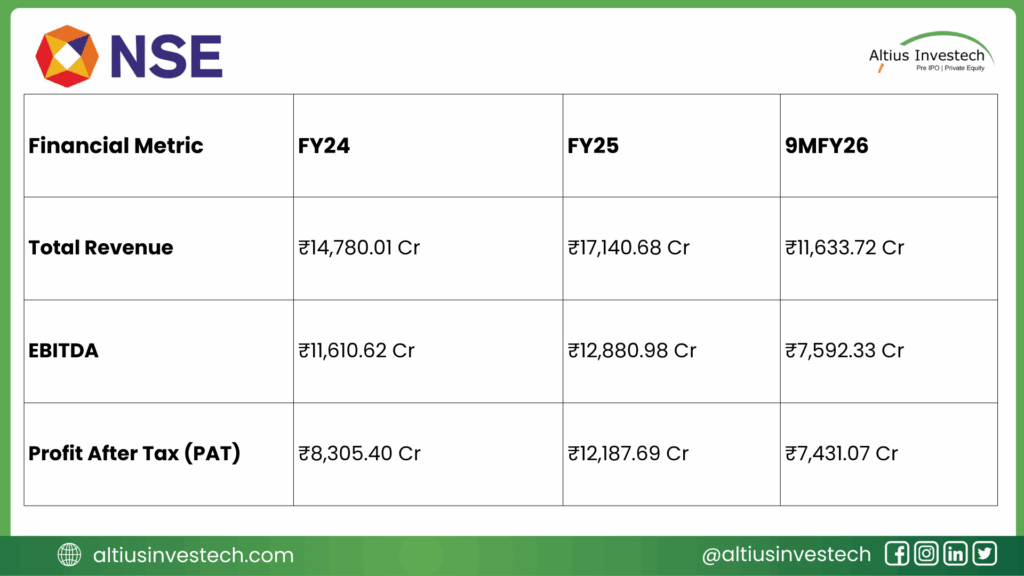
A look at the recent Financial highlights shows this extraordinary financial health:
The exchange is also fiercely dedicated to rewarding its shareholders. In late 2024, it executed a highly popular 4:1 bonus issue (offering four free shares for every one held) to boost liquidity. It followed this with massive dividend payouts, including a final dividend of ₹35 per share in FY25, with a special one-time payout of ₹11.46 per share.
9MFY26 Update
Core Revenue Dip: Revenue from operations fell 13%YoY to ₹11,634 Cr, and EBITDA dropped 24%YoY, driven by softer trading volumes and a 34% increase in technology expenses.
Massive One-Time Gains: Overall profitability was heavily supported by a ₹1,200 Cr pre-tax gain from the NSDL stake sale and the profitable divestment of non-core assets like TalentSprint.
Ancillary & Treasury Growth: Stable, high-margin revenue streams (like data feeds and index licensing) grew 13%, while non-operating treasury income jumped 22% to help cushion core operational drops.
Clearing Regulatory Hurdles: The bottom line absorbed a massive ₹1,307 Cr one-time SEBI settlement provision a short-term financial hit that definitively clears the regulatory path for the upcoming IPO.
What’s Next for the Exchange?
While the historical numbers are staggering, the forward-looking trajectory of the NSE is what truly excites institutional and retail investors alike. Several massive structural tailwinds anchor the future:
1. The Under-Penetration of Capital Markets
Despite crossing 20 crore demat accounts, India’s broader population remains heavily under-invested in equities compared to developed economies like the US. As financial literacy deepens and tier-2 and tier-3 cities continue to enter the formal financial system, the sheer volume of cash and derivatives transactions will naturally compound over the next decade.
2. The GIFT City Offshore Opportunity
The GIFT City represents a massive frontier for the NSE. By offering a unified, tax-efficient gateway for foreign investors, NSE IX (NSE International Exchange) is aggressively capturing offshore derivative volumes that previously went to exchanges in Singapore or Dubai. Volumes here are surging, recently cumulative trading turnover crossing $2.39 trillion in open interest contracts.
3. Diversified, Recurring Tech Revenues
The NSE is no longer just a transaction-fee business. It is aggressively expanding its high-margin ancillary services. Income from live data feeds for algorithmic platforms, and Nifty index licensing services to mutual funds are creating incredibly sticky, recurring revenue streams that are immune to daily market volatility.
How to Buy NSE Shares Before the IPO
For investors tracking the NSE share price today and looking to participate before the public listing, the NSE Pre-IPO market offers a strategic gateway. Institutions and retail investors alike can seamlessly navigate the unlisted shares of NSE through platforms like Altius Investech. As a trusted facilitator and primary executor of unlisted and pre-IPO shares, Altius Investech provides secure, transparent, and efficient access to high-value unlisted equities like the NSE, allowing forward-thinking investors to lock in their positions ahead of the listing.
GET IN TOUCH WITH US:
For any query/ personal assistance feel free to reach out at support@Altiusinvestech.com or call us at +91-8240614850.
Learn, more about Unlisted Companies
Join our Whatsapp Channel: The Market Buzz by Altius
📜 Disclaimer
(Data from from public sources & altiusinvestech.com. For educational purposes only; not investment advice. Altius Investech is not SEBI-registered; investors should do their own due diligence.)