National Stock Exchange Ltd. (NSE)
National Stock Exchange Ltd. (NSE)

INE721I01024
Incorporation Date: 27-Nov-1992
Listing Status: Now Listed
About National Stock Exchange Ltd. (NSE)
Overview of National Stock Exchange Ltd. (NSE)
The National Stock Exchange of India (NSE) has announced a significant revamp of its share transfer process ahead of its highly anticipated IPO, aiming to make the system faster, simpler, and more accessible for investors. Effective from Monday, March 24, 2025, NSE shares will now be transferable through the Delivery Instruction Slip (DIS), reducing the share transfer timeline drastically—from the earlier 2 to 4 months down to just 3 to 5 days. This streamlined process allows NSE shares to be moved as seamlessly as other unlisted securities.
Previously, transferring NSE shares required Stage I and II approvals involving KYC checks and ‘fit and proper’ assessments by NSE itself. These steps have now been eliminated. Instead, the responsibility of verifying transfers will lie with the depositories, which will also lift the earlier ‘freeze’ status on such shares. Additionally, the activation of NSE’s International Securities Identification Number (ISIN) is expected to significantly boost liquidity, increase trading volumes, and attract more investor interest in NSE shares as the exchange prepares for its public offering.
Impact on Investors
Faster Transactions: Investors can now receive NSE shares in just 3-5 days instead of waiting months.
Lower Costs & Improved Access: The streamlined process makes NSE shares more attractive to retail and institutional investors.
Boost in Liquidity & Trading Activity: With over 20,000 shareholders, NSE’s share transfers will become more dynamic in the unlisted market.
Timeline
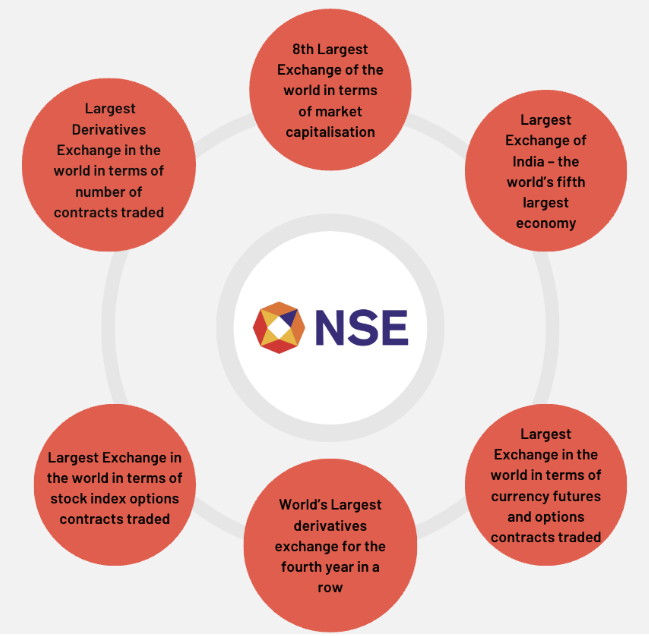
NSE was incorporated in 1992. It was recognised as a stock exchange by SEBI in April 1993 and commenced operations in 1994 with the launch of the wholesale debt market, followed shortly after by the launch of the cash market segment.
1993 : NSE recognized as exchange in India
1994 : Screen based trading introduced by NSE
2000 : Derivatives trading in India was offered through launch of index futures by NSE
2002 : ETFs in India were introduced by NSE
2008 : Currency derivatives were introduced in India by NSE
2011 : Commenced trading in index futures and options contracts on the FTSE Index
2016 : Promoted NSE IFSC, the international stock exchange in India’s first IFSC SEZ at gift city Gandhinagar
2021 : NSE registered investor base surpasses 5 crore unique investors
Landscape of exchanges in India
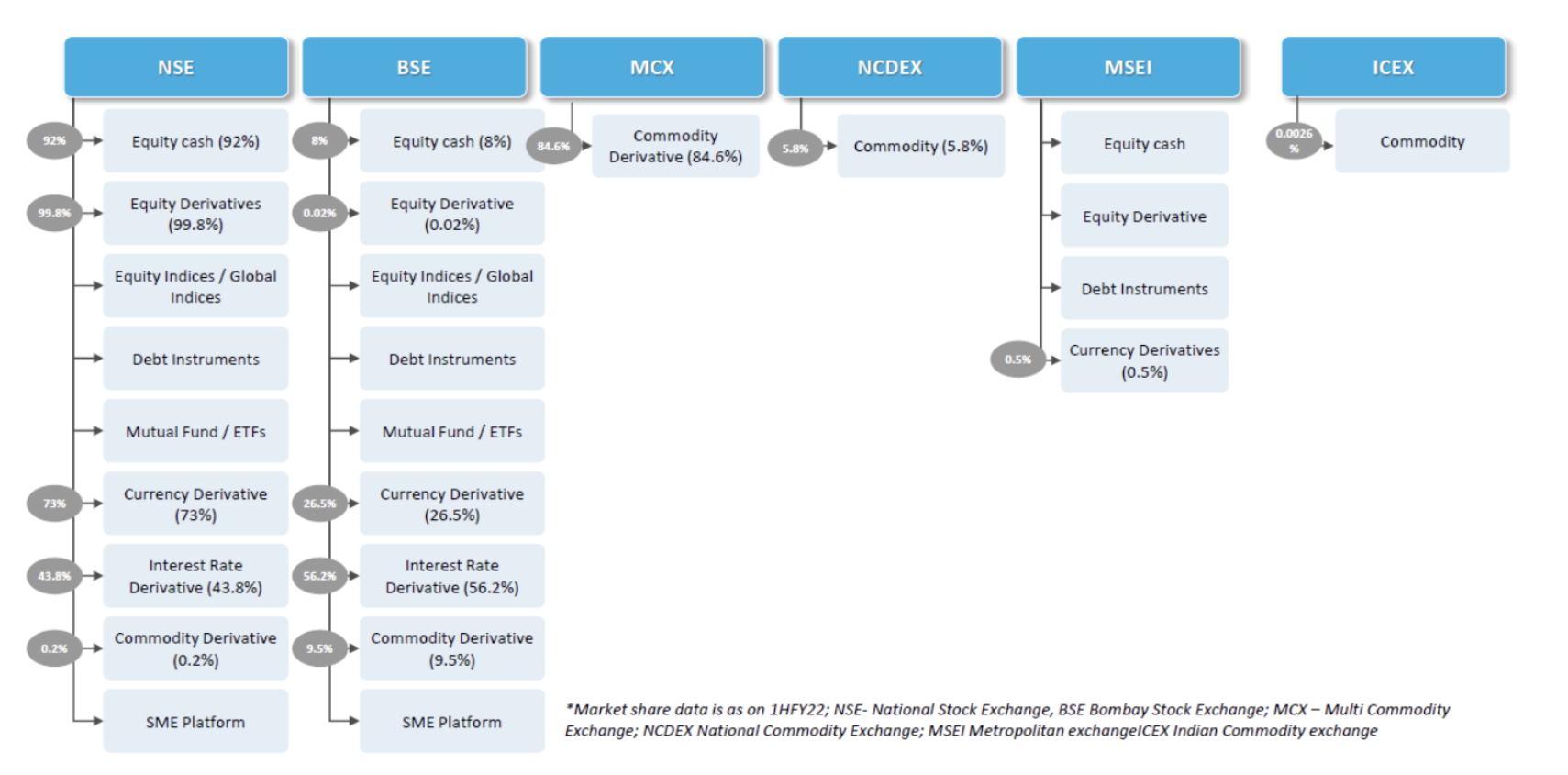
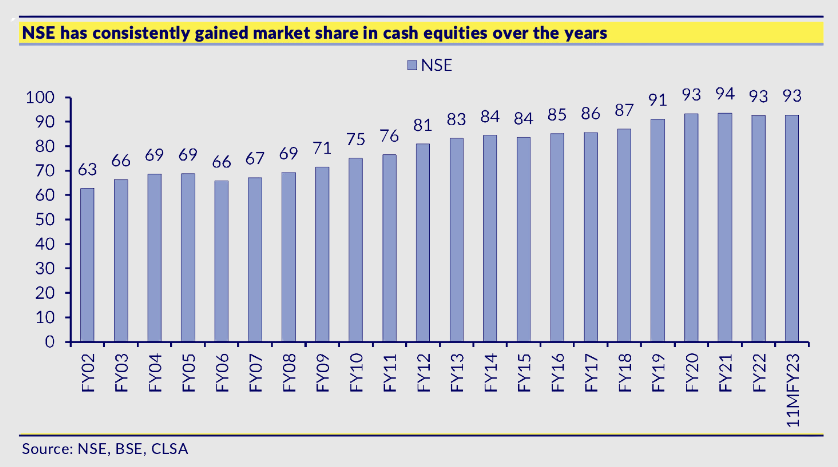
NSE’s market share in cash equities has grown consistently over the past two decades – from 63% in FY02 to 81% in FY12 and further to 92% in FY22. Introduction of co-location facilities in 2009 led to a sharp spike in its market share over the ensuing few years due to increased algorithmic (algo) trading.
Revenue Model
Unlike global exchanges, NSE have high dependency on transaction charges: while BSE’s dependence is low due to poor market share
Transaction Charges
- Charges based on turnover under various categories
- Linked to market activity levels and household savings and investments
Treasury income on clearing and settlement funds
- Revenue from clearing corporation
- Interoperability related income
- interest income from SGF gets added to the SGF account
- Linked to interest rates and to an extent market activity since that would lead to more margin being deposited by members
Tech and information solutions
- Colocation, Network, Platform and terminal charges
- Primarily consists of charges recovered from members for network connectivity
Services to corporates
· Listing fees
· Book building fees
· Mostly derived from listing income that is not impacted by market activity
· Book Building is linked to primary fund raising
Data dissemination fees
· Live Data feeds to third party aggregators
· Historical data for back testing
· Impacted primarily due to level of subscriptions and revision in pricing policies
Income from Investments and deposits
· Income from own cash (not clients money)
· Linked to investment yields
Other Income
· Recurring in Nature
· Mostly derived from rent and training institution, etc
Under penetration of capital markets
More corporates expected to tap the financial markets.
NSE winning the client race
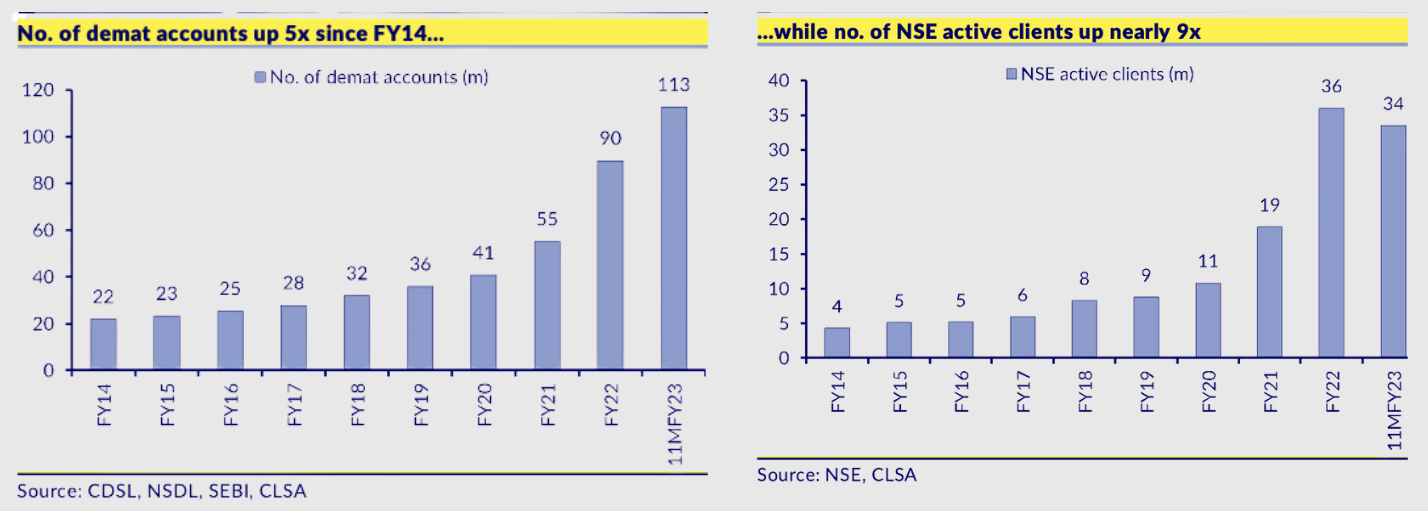
Demat accounts have increased fivefold from 2.2 crores in FY14 to 11.3 crores currently. In contrast, NSE now has 3.4 crores active customers, up from 40 lakhs in FY14—a nearly 9x increase.
NSE gaining market share
NSE holds a 93% market share in cash segment and almost 99% market share in the F&O segment.
Insights of National Stock Exchange Ltd. (NSE)
Financial Highlights (Consolidated)
| Particulars (₹ Cr) | FY26 | FY25 | YoY Growth |
|---|---|---|---|
| Total Revenue | 16,601 | 17,141 | -3% |
| EBITDA | 11,098 | 12,647 | -12% |
| PAT | 10,302 | 12,188 | -15% |
| EPS (₹) | 41.62 | 49.24 | -15% |
| ROE | 33% | 45% | -27% |
The moderation in FY26 profitability was primarily driven by:
- Higher regulatory settlement-related expenses
- One-time labour code provisions
- A high base effect from FY25
However, operational trends remained healthy throughout the year.
Q4 FY26 Recovery Highlights
- Total Income rose to ₹5,360 crore, up 22% YoY
- Revenue from Operations increased to ₹4,968 crore, up 32% YoY
- Operating EBITDA grew 30% YoY
- PAT for Q4 FY26 stood at ₹2,871 crore
The strong quarterly rebound was largely supported by higher derivatives activity and increased market participation.
Segment-Wise Revenue Drivers
While trading income remains NSE’s largest revenue contributor, the exchange continues to diversify into high-margin technology and data businesses.
| Revenue Drivers (₹ Cr) | FY26 | FY25 | YoY Growth |
|---|---|---|---|
| Transaction Charges | 13,057 | 13,636 | -4% |
| Listing Services | 352 | 314 | 12% |
| Data Center & Connectivity | 1,334 | 1,258 | 6% |
| Index & Data Subscription | 152 | 121 | 26% |
Key Takeaways
Transaction Charges
- Contributed nearly 76% of Q4 FY26 revenue
- Q4 transaction charges surged 39% YoY to ₹4,077 crore
- Equity derivatives continued to remain the largest earnings driver
Data Center & Connectivity
- Rack charge revenues increased 33% YoY
- Growth reflects rising institutional participation and increasing demand for co-location infrastructure
Index & Data Business
- Revenue from index licensing and market data subscriptions grew 26% YoY
- Indicates rising monetization of NSE’s proprietary market ecosystem
Deep Dive: Options Boom & Market Leadership
The National Stock Exchange of India continues to dominate India’s exchange ecosystem and remains one of the largest derivatives exchanges globally.
Market Share Leadership
- 93% market share in India’s cash market
- Nearly 100% market share in equity futures and currency derivatives
Equity Options Continue to Drive Growth
- Equity options premium ADV grew 43% QoQ during Q4 FY26
- Options now contribute approximately 77% of total transaction charge revenue
The growing contribution of options reflects:
- Higher retail participation
- Increased hedging activity
- Strong institutional derivatives trading volumes
New Growth Segments
The Electricity Futures segment, introduced in July 2025, gained rapid traction:
- Achieved approximately 72% market share by FY26-end
This marks NSE’s continued expansion beyond traditional equity and currency products.
Contribution to the Indian Exchequer
In FY26, NSE contributed approximately ₹59,186 crore to the national exchequer through taxes, duties, and regulatory fees.
| Contribution Type | Amount (₹ Cr) |
|---|---|
| STT / CTT | 48,345 |
| Income Tax & GST | 6,422 |
| Stamp Duty | 3,411 |
| SEBI Fees | 1,008 |
This highlights the exchange’s significant role in India’s broader financial and taxation ecosystem.
One-Off Costs & Regulatory Impact
The decline in FY26 PAT was substantially impacted by elevated non-recurring expenses.
Major Cost Components
SEBI Settlement Fees
- FY26: ₹1,432 crore
- FY25: ₹670 crore
This remained the largest drag on profitability during the year.
Labour Code Provisioning
- One-time impact of approximately ₹126 crore
Core SGF Contribution
- Contribution reduced to ₹1 crore in FY26
- Compared to ₹234 crore in FY25
Meanwhile, the total Core Settlement Guarantee Fund corpus stood at:
- ₹13,079 crore as of March 2026
Peer Comparison & Valuation
NSE continues to command strong investor interest in the unlisted market, especially relative to its listed peer, BSE.
| Metric | NSE | BSE |
|---|---|---|
| Price (₹) | 2,020 | 3,726 |
| Market Cap (₹ Cr) | 4,99,950 | 1,51,768 |
| P/E (x) | 48.52 | 69.60 |
| P/S (x) | 26.72 | 17.40 |
| ROE (%) | 33% | 36% |
Note: NSE’s share price and EPS are adjusted for the 4:1 bonus issue.
Valuation Insights
- NSE trades at a lower P/E compared to BSE despite significantly larger scale
- Strong profitability and market leadership continue to support premium valuations in the unlisted market
Shareholding & Strategic Updates
Key Institutional Shareholder
-
Life Insurance Corporation of India remains the largest domestic institutional shareholder with a 10.72% stake.

Bonus Issue
- NSE completed a 4:1 bonus issue
- Share price and earnings metrics have been adjusted accordingly
NSE IFSC / GIFT City Expansion
The exchange’s international platform at GIFT City continued to scale rapidly.
NSE IX Highlights
- Total fund mobilization reached approximately $18.7 billion during FY26
- Strengthening India’s positioning as an international financial services hub
The Road to IPO
The long-awaited IPO of the National Stock Exchange of India remains one of the most closely watched developments in India’s capital markets.
While historical regulatory overhangs — particularly the co-location matter — delayed the listing process, several key developments have improved sentiment:
- Supreme Court directives related to earlier proceedings
- Completion of the bonus issue
- Stabilization of core profitability
- Continued market leadership across segments
With regulatory clarity gradually improving, market participants continue to watch closely for updates regarding NSE’s IPO timeline.
Financial Charts of National Stock Exchange Ltd. (NSE)
Balance Sheet of National Stock Exchange Ltd. (NSE)
Profit and Loss of National Stock Exchange Ltd. (NSE)
Ancillary of National Stock Exchange Ltd. (NSE)
Ratio Analysis
Peers
Industry Benchmarking
Segment Revenue
Subsidaries
Security Allotment
Corporate Governance
Team Management Details
FAQs of National Stock Exchange Ltd. (NSE)
-
How to buy National Stock Exchange Ltd. (NSE)?
Below are three ways through which you can purchase National Stock Exchange Ltd. (NSE):
- We at Altius Investech have many actively traded scripts and are market makers of unlisted shares. To check out all the unlisted shares traded. (Click on link). To submit a request to buy National Stock Exchange Ltd. (NSE), please click on the trade button at the top of this page
- Additionally, you can download our app from your play store or app store, register on our application, and engage in active trading there.
Download the Altius App here https://onelink.to/hf4m72 - You can also reach out to us at : +91 8240614850 / +91 8240861716
-
How to sell National Stock Exchange Ltd. (NSE)?
Below are three ways through which you can sell National Stock Exchange Ltd. (NSE):
- We at Altius Investech have many actively traded scripts and are market makers of unlisted shares. To check out all the unlisted shares traded. (Click on link). To submit a request to sell National Stock Exchange Ltd. (NSE), please click on the trade button at the top of this page
- Additionally, you can download our app from your play store or app store, register on our application, and engage in active trading there.
Download the Altius App here https://onelink.to/hf4m72 - You can also reach out to us at : +91 8240614850 / +91 8240861716
-
What is the price of National Stock Exchange Ltd. (NSE)?
We provide a two way quote on all the shares we deal in. Your buy price for National Stock Exchange Ltd. (NSE) is ₹1950 and your sell price for National Stock Exchange Ltd. (NSE) is ₹1850. The price is based on our estimates and market conditions.
-
What is the lock-in period of National Stock Exchange Ltd. (NSE)?
The lock-in period for National Stock Exchange Ltd. (NSE) varies depending on the category of investors:
- For retail Investors, HNIs, or Body Corporates, the lock-in period is 6 months from the date of the listing of National Stock Exchange Ltd. (NSE)
- For Venture Capital Funds or Foreign Venture Capital Investors, there is a lock-in period of 6 months from the date of acquisition of National Stock Exchange Ltd. (NSE)
- For AIF-II (Alternative Investment Funds - Category II), there is no lock-in period
August 2021 saw the introduction of this regulation by SEBI. The purpose of the regulation change, which lowered the lock-in period from a year to six months, was to incentivize additional investments in firms getting ready for initial public offerings, or IPOs. Since its introduction, a number of Portfolio Management Services (PMS) have advised their clients to purchase Pre-IPO shares in order to take advantage of the advantages associated with early-stage investments. This reduction in the lock-in period is considered as a significant step forward.
-
How is the National Stock Exchange Ltd. (NSE) price calculated?
Fundamental & Comparative valuation models and the forces of demand and supply in the market for unlisted shares dictate the price. These prices are based on our estimates and transaction history of National Stock Exchange Ltd. (NSE). The price is also determined from the most recent funding round for National Stock Exchange Ltd. (NSE). This provides us with a benchmark valuation, offering a clear indication of the company's current market value as perceived by investors and industry experts.
-
What are the lot sizes of National Stock Exchange Ltd. (NSE)?
We can generally arrange lot sizes starting with an investment of INR 20,000. To confirm the lot sizes of National Stock Exchange Ltd. (NSE) with us kindly click here.
-
What are the financials of National Stock Exchange Ltd. (NSE)?
The financials of National Stock Exchange Ltd. (NSE) which includes the P/L of National Stock Exchange Ltd. (NSE) and the Balance Sheet of National Stock Exchange Ltd. (NSE) is in the financials section (Click on link).
-
Where can I find the annual report of National Stock Exchange Ltd. (NSE)?
The annual report of National Stock Exchange Ltd. (NSE) is available in the annual report section (Click on link).
-
Is buying National Stock Exchange Ltd. (NSE) legal in India?
Yes, buying and selling unlisted shares in India is indeed 100% legal. This activity is regulated and governed under the guidelines provided by the Securities and Exchange Board of India (SEBI). Investors and traders must adhere to these regulations and guidelines to ensure compliance with legal and financial standards. It's important for participants in the unlisted share market to be aware of and understand these regulations to engage in transactions legally and securely.
-
Short-term Capital Gain taxes to be paid on National Stock Exchange Ltd. (NSE)?
When you sell unlisted shares within a period of two years from the date of acquisition, any profit earned from the sale is classified as Short-term Capital Gain (STCG). This gain is then added to your total income for that financial year. The tax on this short-term capital gain is calculated based on your applicable individual income tax slab rates. Therefore, the rate at which you will pay tax on the STCG from unlisted shares depends on your total income, including this gain, and the tax slab it falls under as per the prevailing income tax laws in India. It's important for investors to consider these tax implications when engaging in transactions involving unlisted shares.
-
Long-term Capital Gain taxes to be paid on National Stock Exchange Ltd. (NSE) and how are They Taxed?
Long-term Capital Gains (LTCG) on unlisted shares in India refer to the profits earned from the sale of unlisted shares that have been held for more than two years. The key aspects of LTCG on unlisted shares include:
- Tax Rate: LTCG on unlisted shares is taxed at a rate of 20%.
- Indexation Benefit: This is a significant advantage for investors. Indexation allows for adjusting the purchase price of the shares for inflation, which can reduce the taxable gain.
- Importance for Investors: Understanding LTCG is crucial, especially for High Net-worth Individuals (HNIs) and retail investors, as it impacts their investment strategy and tax planning. Knowing these details helps in making informed investment decisions.
- Calculation: LTCG is calculated by subtracting the indexed cost of acquisition (the purchase price adjusted for inflation) from the sale price of the shares. The profit thus calculated is subject to a 20% tax.
- Applicability: LTCG tax is applicable to profits from the sale of unlisted shares held for more than two years.
- Relevance: This tax is particularly relevant to investors in the unlisted share market, including those considering selling their holdings after a period of more than two years.
-
Applicability of Taxes on National Stock Exchange Ltd. (NSE) once it is listed?
When shares initially bought in the unlisted market become listed, the taxation rules change significantly if these shares are sold through a stock exchange. Here's what investors need to know:
Transition to Listed Market Tax Rates: Once unlisted shares are listed on the stock exchange and subsequently sold, the tax rates applicable to listed securities come into effect. This shift means that the favourable tax treatments for listed shares, as per the prevailing tax laws, will apply.
Taxation Based on Holding Period: The crucial factor in determining the type of capital gains tax (Long-term or Short-term) is the holding period of the shares. Importantly, this period is calculated from the original purchase date when the shares were unlisted.
Long-term vs. Short-term Capital Gains: If the shares are sold after being held for more than one year from the date of purchase (including the period when they were unlisted), they are subject to Long-term Capital Gains (LTCG) tax.
Conversely, if sold within one-year, Short-term Capital Gains (STCG) tax rates apply.
Significance for Investors: This information is vital for investors in the unlisted market, as it impacts their tax planning and decision-making process. Understanding these nuances ensures that investors can strategically plan the sale of their shares post-listing to optimize tax implications.
Advice for Investors: It's advisable for investors to keep a record of their purchase dates and monitor the listing dates closely. Additionally, staying updated with the latest tax regulations or consulting with a financial advisor is recommended for accurate tax calculations and compliance. -
How does Altius Investech source National Stock Exchange Ltd. (NSE)?
At Altius Investech, our approach to sourcing National Stock Exchange Ltd. (NSE) unlisted shares involves a strategic and direct method. Primarily, we acquire these shares from the below key groups:
Employees of the Company: Employee stock option plans (ESOPs) or other compensation packages frequently include shares for firm employees. For a various reasons, such as including portfolio diversification or financial considerations, some of these employees may eventually choose to sell their shares. We engage with these employees, providing them a platform to sell their shares.
Initial Investors: These are the angel or early-stage investors who provided capital to the business in its early stages. These original investors may look to sell all or part of their ownership position in the company as it develops and flourishes. This might be done for various reasons such as in order to maximise their investment, reallocate resources, or make other calculated financial decisions.
Funding rounds and VC funds: Altius Investech sources the shares from private placement rounds in which private companies seek to obtain capital from the market. Through our platform, venture capital funds can liquidate their shares and we receive the inventory from them when they decide to sell a portion of their ownership through block trades.
By establishing connections with these groups, Altius Investech guarantees our clients a steady and dependable supply of National Stock Exchange Ltd. (NSE) unlisted shares. This process not only makes it easier for employees and initial investors in liquidating their assets, but it also gives our clients access to shares that aren't often found on the open market. Our platform effectively facilitates a win-win situation for both buyers and sellers. -
How to trust Altius Investech before buying National Stock Exchange Ltd. (NSE) from its platform?
Altius Investech stands at being India's fastest growing and leading marketplace for buying and selling unlisted shares. We believe in enabling access to alternative sources of investments at lower entry barriers to private equity investments.
With more than 25 years of experience, Altius Investech has carved a niche in the financial market by serving more than 8000 clients. The incredible journey is further highlighted by the vast number of transactions that Altius Investech has facilitated transactions that have already exceeded 300 crores.
For investors Altius Investech curates investment opportunities in companies at reasonable valuations which are on the verge of an IPO leading to massive value unlocking. Investments are backed by thorough research and sound investment thesis, with a time bound exit plan.
For ESOP Shareholder and existing Investors, we assist them to liquidate their shares even if they are not publicly traded by creating a platform where we find the right buyers and sellers for the best prices.
Altius Investech have been featured in top media news outlets like Economic Times, Financial Express, Money control. Check out about us on these - leading publications (Click on link) Our journey over these years has not just been about numbers; it's been about building trust and reliability.
We at Altius Investech are dedicated to upholding the greatest levels of ethics and transparency, making sure that your investment experience is not only profitable but also safe and reliable.
Press of National Stock Exchange Ltd. (NSE)
Featured Blogs of National Stock Exchange Ltd. (NSE)
Annual Report of National Stock Exchange Ltd. (NSE)
Company Information of National Stock Exchange Ltd. (NSE)
Featured Companies






















































































































India's most trusted Platform for Buying and Selling Unlisted Shares
Social Media





Join our WhatsApp Community
Altius Investech
Altius Investech Private Limited


Download Our App


Startup India Certificate No.
DIPP43865
CIN No.
U74900WB2016PTC210376
