
India is in the middle of one of the most ambitious energy transitions the world has ever seen. With a target of 500 GW of renewable energy capacity by 2030, the country is rapidly building the infrastructure, manufacturing muscle, and policy architecture to become a global clean energy powerhouse. For investors, this transition is not just a policy story — it is a wealth creation opportunity. And some of the most compelling plays are not on a stock exchange yet.
This article dives deep into three companies shaping India’s solar revolution: Onix Renewable Limited, an unlisted Gujarat-based group with staggering growth numbers; and Vikram Solar, a Kolkata-born global brand that recently completed one of India’s most successful solar IPOs.
1. India’s 500 GW Dream: The Tailwind Behind Every Solar Stock
India added roughly 28 GW of solar capacity in FY2025 alone, taking its total installed renewable capacity past 200 GW. The government’s 500 GW non-fossil fuel target for 2030 is not just a number — it is a policy commitment backed by production-linked incentives (PLI), Approved List of Models and Manufacturers (ALMM) regulations, and aggressive solar park development.
Domestic manufacturing has become a national priority. With import duties on Chinese panels and cells, India-made modules now command a structural advantage in large government tenders. This is the environment in which companies like Onix Renewable and Vikram Solar are building their businesses. The opportunity is generational, and the companies that can execute — whether in module manufacturing, EPC project delivery, or grid infrastructure — stand to create enormous value for their shareholders.
2. Onix Renewable Limited — The Unlisted Juggernaut from Gujarat.
Headquartered in Rajkot, Gujarat, Onix Renewable is engaged in the wholesale and retail trading of fabricated metal products, solar panels, wind turbines, transmission and distribution equipment, and consumer electronics. More importantly, the company provides end-to-end supply and service for hybrid renewable projects — solar plus wind — along with installation, liaisoning, and technical advisory services across field projects.
Onix Renewable — Financial Snapshot
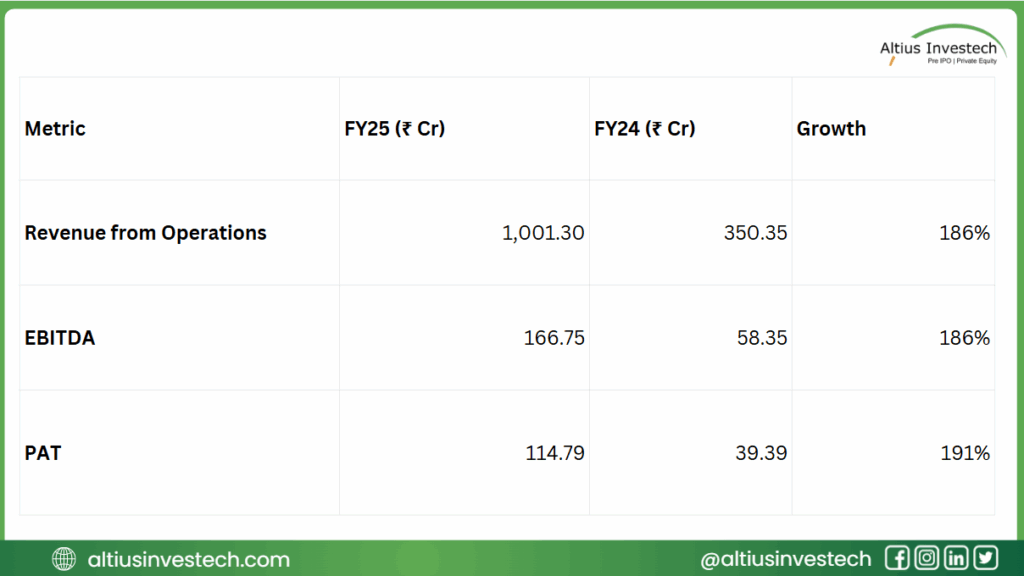
A near 3x revenue jump in a single year — this is not incremental growth; this is a company firing on all cylinders in a market that is begging for execution. Net profit nearly tripled year-on-year, with earnings per share hitting ₹560.68 — a remarkable figure for an unlisted company. Total assets on the consolidated balance sheet reached ₹1,072.58 crore, with total equity (share capital plus reserves) standing at approximately ₹705.62 crore — a significant shareholder wealth base.
The group structure is expansive. Onix Renewable’s subsidiaries include Onix Tech Renewable Private Limited (revenues of ₹9,969.50 Lakhs, net profit of ₹921.65 Lakhs) and Onix Trans Technovrates Private Limited (revenues of ₹6,382.76 Lakhs). The group has also made strategic acquisitions, picking up stakes in Nexusgate Ventures Limited and Onix Fusion Ventures Private Limited during FY25, signalling aggressive expansion into new project verticals.
Key financial ratios from the FY25 report underscore the business quality: the net profit margin improved to 11.46% (from 5.89% in FY24), the debt-equity ratio dropped sharply from 1.00 to 0.24 — meaning the company is becoming far less leveraged even as it scales — and the current ratio improved from 1.14 to 2.57, indicating significantly stronger liquidity.
For unlisted market participants, Onix Renewable represents exactly the kind of high-growth, improving-profitability business that typically commands premium valuations by the time it approaches a public listing. The company converted into an unlisted public company during FY25, which is often a precursor to IPO activity. Watch this space closely.
3. Vikram Solar — From Unlisted Giant to Listed Powerhouse
While Onix Renewable is the emerging story, Vikram Solar Limited is the proof of what India’s solar sector can deliver to public market investors — and what it looks like when an unlisted solar company finally goes public.
Founded in 2005 by Gyanesh Chaudhary, Vikram Solar is headquartered in Kolkata and has spent two decades building one of India’s most respected solar brands. From a modest 12 MW module manufacturing plant in Falta, West Bengal in 2009, the company has grown to a current installed manufacturing capacity of 4.5 GW — a journey that took the company from local ambition to global recognition.
The FY2024-25 annual report, themed “20 Years: From Vision to Velocity,” captures the scale of this transformation. Vikram Solar has now shipped more than 7 GW of solar modules globally, serves customers across multiple continents, and operates an EPC portfolio of 1.41 GW commissioned and under execution across ground-mount and rooftop solar projects in India. In FY25 alone, the company manufactured 1,286.10 MW of solar modules and commissioned 27.7 MW of EPC projects.
Vikram Solar — Financial Snapshot
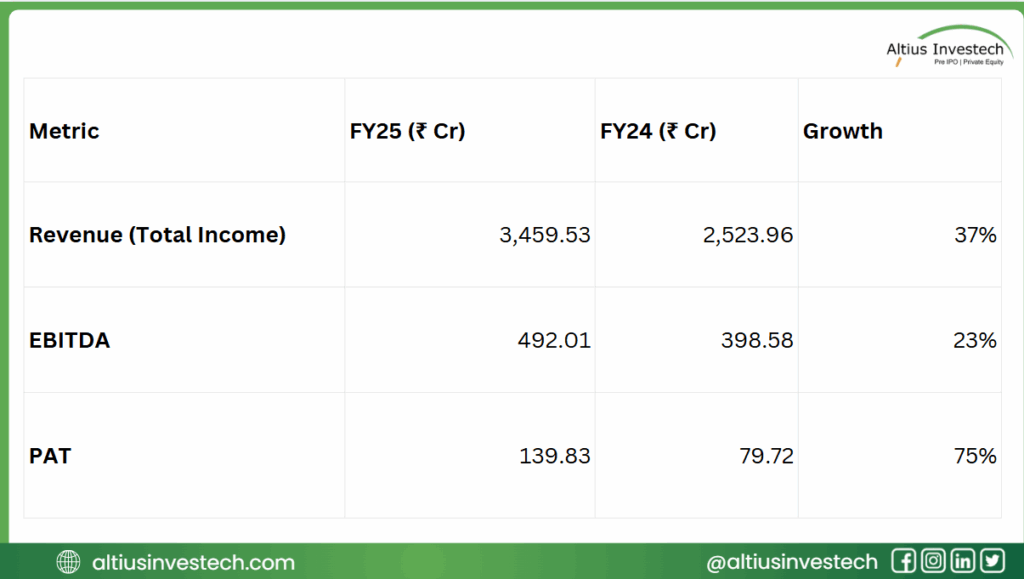
While near-term profitability was compressed by IPO costs and heavy investment, the operational scale tells the real story: 4.5 GW of manufacturing capacity, 7+ GW shipped globally, and a freshly listed stock that was subscribed 55 times by the market. The company’s R&D lab in Falta, West Bengal holds NABL accreditation under ISO/IEC 17025:2017 standards — making it the second solar company in India and the first in eastern India with such recognition. The company has also received KIWA PVEL’s ‘Top Performer’ title for the eighth time in the last nine years, a globally recognised quality benchmark that serves as a key shortlisting criterion for buyers in the United States market.
Most significantly for investors, 2025 marked Vikram Solar’s IPO. The offering opened for subscription from August 19 to August 21, 2025, comprising a fresh issue of approximately 4.52 crore equity shares aggregating to ₹1,500 crore and an offer for sale of approximately 1.75 crore shares at ₹579 crore — taking the total issue size to roughly ₹2,079 crore. Ahead of the public opening, the company raised ₹621 crore from marquee anchor investors including Kotak Mutual Fund, Goldman Sachs Funds, Franklin Templeton Mutual Fund, Morgan Stanley Investment Funds, and Tata Mutual Fund.
The public response was extraordinary. The IPO was subscribed nearly 55 times in aggregate — Qualified Institutional Buyers (QIBs) subscribed approximately 145 times their reserved portion, Non-Institutional Investors (NIIs) came in at approximately 53 times, and the retail portion was subscribed close to 8 times. Vikram Solar’s shares listed on BSE and NSE on August 26, 2025 — and as the company itself noted, it emerged as the most preferred IPO among four simultaneous listings on that day.
This is what happens when a well-run, globally respected unlisted solar company finally opens its books to the public. The lesson for investors: the best time to enter was before the listing. Looking ahead, Vikram Solar has announced plans to develop a 3 GW cell and 6 GW module facility in Tamil Nadu and a 1 GWh solid-state battery manufacturing facility expandable to 5 GWh — positioning itself at the frontier of India’s energy storage ambitions.
4. How to Invest in Clean Energy Unlisted Stocks
For retail investors eager to participate in India’s clean energy boom before companies like Onix Renewable reach the IPO stage, the unlisted (pre-IPO) market offers a legitimate pathway — but it requires careful navigation.
Unlisted shares are traded through intermediaries, ESOP transfers, promoter sales, or registered brokers who facilitate deals outside stock exchanges. Platforms and brokers specialising in unlisted securities can help you access shares in companies like Onix Renewable at valuations that may be considerably lower than eventual IPO pricing.
Key considerations before investing: First, verify the company’s financials through available annual reports — as demonstrated above, Onix Renewable’s consolidated accounts are detailed and audited. Second, understand the liquidity risk: unlisted shares cannot be sold on exchanges, and exit may depend on the company’s IPO timeline or finding a secondary buyer. Third, be aware of the tax treatment — unlisted shares held for over 24 months qualify as long-term capital assets, attracting a 20% tax with indexation benefit (or 12.5% without indexation under the updated regime), while shorter holding periods attract slab-rate taxation.
The Bottom Line
India’s solar revolution is one of the defining economic stories of this decade. Onix Renewable’s near-tripling of revenues, Vikram Solar’s blockbuster IPO subscribed 55 time all point to the same conclusion: the companies executing in India’s clean energy space are creating real, auditable value. The question is not whether to participate — it is when, and through which vehicle.